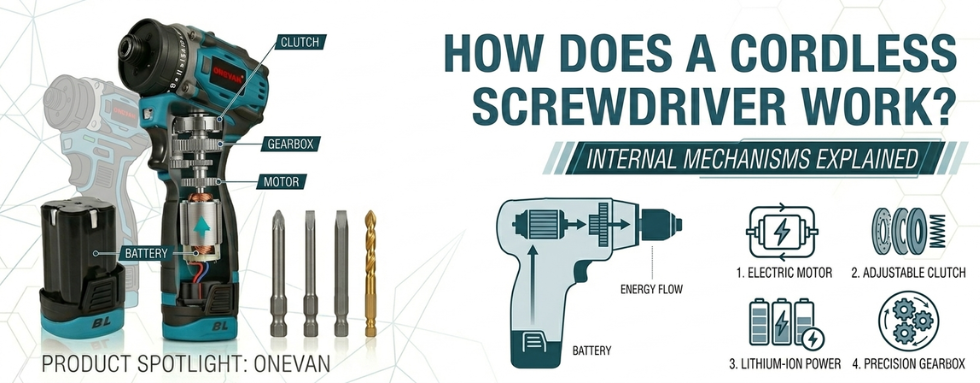
Grand View Research published a report in 2023 and claimed that more than 65% of professional tools sold today are cordless. This number grows every year. If you use a cordless screwdriver, you should know how it works. This helps you get better results and keep the tool from breaking.
1. What Are Screwdrivers and Why Are They Important
At its most basic, a screwdriver turns a screw. It applies rotational force to the screw head so the thread either goes into the material or comes back out. The four main types of screwdrivers are manual, pneumatic, corded electric, and cordless electric, each differing in their power source and application.
2. From Traditional to Cordless: The Development History of Screwdrivers
Manual Screwdrivers
A manual screwdriver runs on hand pressure and turning force. For a few screws, this works fine. For a full day of work, the wrist tires, the grip weakens, and the force behind each screw becomes uneven. Some screws go in too shallow, others too deep, and some heads strip. This problem pushed people toward powered tools.
Pneumatic (Air-Powered) Screwdrivers
The first powered screwdrivers used compressed air. A compressor pushes air through a hose into the tool, which spins a rotor inside and turns the bit. These tools were strong and delivered the same power every time. Car factories and assembly lines started using them in the 1950s.
However, they had a significant limitation. The compressor had to be nearby. Hoses needed space and got in the way. In a factory with air lines built into the walls, this setup worked. On a rooftop, up on scaffolding, or in a small repair shop, it did not. The tool itself was good. The setup was the problem. That problem led to the next step.
Corded Electric Screwdrivers
Corded tools removed the compressor entirely. A motor inside the tool takes power from a wall socket and converts it into rotation. This made the setup simpler and the tool lighter. For any workshop with nearby power points, this was a genuine improvement over pneumatic tools.
The cord, however, created its own limits. In tight corners or crowded spaces, it got in the way. It restricted how far you could move. These were not sufficient reasons to stop using corded tools, but they were enough to encourage further exploration of alternatives. When battery technology improved, the next step became possible.
Cordless Electric Screwdrivers
Cordless screwdrivers use the same motor as corded ones. The only difference is a rechargeable battery in place of the cord. No socket, no hose, no compressor. You can work anywhere.
Lithium-ion batteries, which became common around 2005, made this practical. They were lighter, held more charge, lasted longer, and charged faster than earlier batteries. This made cordless tools a real option for everyday use, not just a convenience.
Today, most workers and homeowners prefer cordless tools for this reason.
3. Changes in Working Principles: Transitioning from Manual, Pneumatic, and Corded to Cordless
The screwdriver has undergone four distinct generational shifts, each driven by a specific limitation in the tool that came before it. Understanding this chain of cause-and-effect reveals not just how each tool works, but why it exists.
1. Manual Screwdrivers
Working Principle
The manual screwdriver is the foundation from which all later tools evolved. It operates entirely on human mechanical input: a handle transmits your grip force through a steel shank to a tip seated in the screw head. There are no internal gears, no power source, and no intermediary systems. The tool is a direct extension of your hand.
Power and Control
Power is limited to wrist strength, but this constraint is also its greatest advantage. Because the operator feels resistance directly through the handle, they can sense the precise moment a screw seats. Choose a tool with a hollow-ground tip and an acetate or rubber-overmold handle; cheap plastic handles can fracture under sustained torque.
The Limitation That Drove Change
In high-volume production environments, the speed and endurance of human muscle became the bottleneck. Factories needed a way to deliver consistent, repeatable torque hundreds or thousands of times per hour without fatiguing a worker. This demand produced the pneumatic tool.
2. Pneumatic Screwdrivers
Working Principle
Pneumatic screwdrivers made the first fundamental break from human-powered mechanics. Rather than converting muscle effort into rotation, they harness compressed air from an external compressor, routing it through the tool body to spin internal turbine vanes. The rotation is mechanical, rapid, and entirely independent of the operator's physical strength — a genuinely new working principle.
Power and Control
As long as the compressor is running, the output is consistent and extremely high. A push-to-start trigger initiates airflow; torque is regulated via an internal spring mechanism. However, adjusting torque mid-task is slow and imprecise. The tool excels in high-volume assembly environments where the same fastener is driven repeatedly at a fixed torque. Because the motor is replaced by lightweight vanes, pneumatic tools are significantly lighter than any electric equivalent.
The Limitation That Drove Change
The air hose was both the tool's power source and its greatest constraint. It tethered the operator to a compressor, restricted mobility, added noise to the workspace, and made the setup impractical outside a dedicated shop or factory floor. The next generation sought to retain the power gains of pneumatic tools while eliminating the hose — and found the solution in household electrical current.
3. Corded Electric Screwdrivers
Working Principle
Corded electric screwdrivers replaced compressed air with a different energy medium: AC power drawn directly from a wall outlet. The incoming current drives an electric motor, which converts electrical energy into rotational mechanical force. This eliminated the compressor, the air reservoir, and the bulky pneumatic hose. The tool could now operate anywhere with a standard outlet — a significant expansion of the working environment.
Power and Control
Runtime is effectively unlimited; unlike batteries, the tool draws constant current and never weakens over a shift. Variable-speed triggers gave operators finer control over rotation, a refinement over the binary on/off of most pneumatic tools. The trade-off was the power cord itself: while less restrictive than an air hose, it still tethers the operator, and cord weight can strain the wrist during sustained overhead or vertical work.
The Limitation That Drove Change
The cord remained the last remaining physical constraint. For construction sites, outdoor work, and any environment without accessible outlets, corded tools were still impractical. Eliminating the cord entirely required a self-contained, portable energy source. It was the rechargeable battery pack, and with it came the most significant engineering leap in the tool's history.
4. Cordless Screwdrivers
Working Principle
Cordless screwdrivers complete the evolutionary arc by eliminating all external dependencies. A Lithium-ion battery pack supplies DC current to a brushless motor, which drives output through a planetary gear system. Every part like energy source, motor, and transmission is self-contained within the tool body. The brushless motor and planetary gearing represent a fundamentally different mechanical architecture, enabling higher torque (up to 60 Nm) from a smaller, lighter package than any previous generation.
Power and Control
The electronic brake stops the motor instantly, the moment the trigger is released, a precision function unavailable in earlier tool types. A mechanical clutch disengages drive the at a preset torque threshold, preventing screw stripping or surface damage. Together, these systems give the operator a level of active, automatic control that the prior three generations could not achieve. For the housing, Glass-Filled Nylon (PA6-GF30) offers the best durability-to-weight ratio; a 2.0Ah battery balances runtime with overall tool weight.
|
Feature |
Manual |
Pneumatic |
Corded |
Cordless |
|
Power Source |
Human Muscle |
Compressed Air |
Wall Socket (AC) |
Battery (DC) |
|
Mobility |
Unlimited |
Restricted by Hose |
Restricted by Cord |
High |
|
Maintenance |
None |
High (Oiling/Air) |
Medium (Cord Check) |
Low (Battery Care) |
|
Precision |
Highest |
Medium |
Medium |
High (Electronic) |
4. How Does a Cordless Screwdriver Work
Core Parts of a Cordless Screwdriver
A battery powered screwdriver has five main parts, and each part has a clear role.
Battery Pack
The battery pack has lithium-ion cells and usually clips into the base. It sends direct current to the motor and to the control electronics.
Electric Motor
Brushed or brushless, depending on the model. It converts electrical energy from the battery into rotational motion. The spinning motor shaft connects to the gearbox.
Gearbox and Clutch
The gearbox slows the motor's fast rotation and increases torque. It works like this:
- You choose the required torque setting.
- The tool turns the screw.
- When the screw is tight enough, the clutch disconnects.
- The chuck stops moving to prevent overtightening
- The motor keeps spinning, but it is no longer pushing the screw.
Chuck and Bit Holder
This is the part that holds the screwdriver bit in place. Most cordless screwdrivers take quarter-inch hex shank bits in a hex chuck. Some models use a keyless chuck for round shank bits instead. Either way, this is the part that transfers rotation from the gearbox to the bit and then to the screw.
Trigger and Controls
Press the trigger lightly, and the motor runs slowly. Press it full,y, and you get maximum speed. There is also a forward/reverse switch and a torque collar on the front of the tool that lets you choose how much resistance the clutch allows before it trips.
Working Principle of a Cordless Screwdriver in Detail
When you pull the trigger, electricity flows from the battery to the motor. The motor spins and if you pull harder, it spins faster.
The Gearbox
The challenge is that the motor spins too fast to effectively drive a screw. Speed is useless here — you need torque. That's where a planetary gearbox comes in. Three components make it work:
- Sun gear — sits in the center
- Planet gears — small gears that spin around it
- Ring gear — the outer ring, fixed in place
The motor drives the sun gear, which pushes the planet gears around. Since the outer ring can not move, the spinning energy has nowhere to go except down, so speed drops and power increases. A motor running at 20,000 RPM might come out the other end at 1,000 RPM. Twenty times slower, and stronger.
The Clutch
Clutch uses small metal balls to control the power.
While driving a screw, the balls remain in place, and the mechanism functions normally. But once the screw seats and resistance build up, those balls get forced out of their holes. You hear a click. The drive stops.
The ONEVAN cordless screwdriver range is built around this mechanism, with up to 21 torque settings across the product line to cover small electronics fixings through to timber screws.
Brushless vs Brushed Motor Technology
Brushed Motors
In a brushed motor, two carbon brushes press against a metal ring on the motor shaft. This is called the commutator. Next, current travels through the brushes into the rotor windings. This creates the magnetic field that drives rotation. The brush-to-commutator contact occurs continuously as the motor operates. The brushes gradually wear down, leave carbon dust inside the tool, and eventually need replacing. Heat builds up from the friction, too.
Brushless Motors
In Brushless motors, the permanent magnets go on the rotor, and the windings remain fixed in the outer casing. A small controller switches current through the stator windings in a special sequence. This creates a rotating magnetic field. The rotor turns as the magnetic field changes. So there is no constant brush contact inside the motor. This means less wear, less heat, and better use of battery power.
In use, this means more work from each battery charge, a longer motor life, and better electronic control over speed and torque. This is why many professional cordless tools now use brushless motors.
The ONEVAN brushless cordless screwdriver kit uses brushless technology with 21+2 torque settings and includes a 14-piece accessory set, which covers most assembly and construction fastening tasks without needing to buy bits separately.
5. Application Case Studies of Cordless Screwdrivers
Cordless Screwdrivers in Electronics Manufacturing
Control is especially important in electronics work. The screws are small, the parts are fragile, and the spaces are tight. Too much torque can crack a PCB. Too little can leave the screw loose. This kind of work needs fine, low-torque control, where the steps between settings are small enough to get the force right for each job. Weight is also a critical factor; assembly operators often hold these tools at awkward angles for extended periods, and a heavier tool can lead to increased fatigue compared to a lighter one. A cordless screwdriver, with its adjustable torque and compact build, suits this work better than a pneumatic or corded tool.
Cordless Screwdrivers in Automotive Repair
Automotive repair involves many types and sizes of fasteners. Small screws for interior trim and larger fixings for mechanical Parts. A battery powered screwdriver covers the lower and mid torque range well: door panels, seat frames, under-bonnet electrical connectors, dashboard Parts. For a workshop where the tool runs most of the day, battery capacity matters. A higher amp-hour rating means the voltage stays steadier across the discharge, so the torque at the end of a charge is close to the torque at the start.
Cordless Screwdrivers in Furniture Assembly
Flat-pack furniture often requires repeated screwdriving into MDF, softwood, and similar materials. MDF in particular strips quickly if the screw is driven too hard. Getting the clutch set correctly at the start of a job saves a lot of damaged fittings. Because this work is continuous and the tool ends up held at all sorts of angles, the grip and the weight of the tool have a direct effect on how the hands and wrists feel by the end of the day. A cordless screwdriver handles this work well. The adjustable clutch gives enough control to protect the material, the lack of a cord means you can move freely around a piece of furniture, and a lightweight build reduces strain over a long session.
6. How to Select the Right Cordless Screwdriver Model and Settings
Check Torque Range
Torque range is the first thing to check. Small screws in soft materials need a tool that starts low and adjusts in small steps. Larger fixings in hardwood or metal need a higher maximum.
Check Battery Capacity
Next, check the battery capacity. For example, a 2.0Ah pack gives about half the runtime of a 4.0Ah pack doing the same work. For occasional home use, a smaller battery is usually enough. Similarly, if you want to work a full day, the difference is significant enough to justify a higher-capacity battery.
Consider Weight
Weight is also important, especially when you want to use the screwdriver for a long time. Brushless models are very light, and the power level is also impressive.
7. Maintenance and Care Guide for Cordless Screwdrivers
Lithium-ion Battery Care and Storage Tips
Draining a lithium-ion battery completely can weaken the cells over time. Leaving it fully charged for weeks can also shorten battery life. Both habits shorten how many charge cycles the battery lasts. If you are storing a tool for more than a few days, somewhere between 40% and 60% charge is better for the cells than either extreme.
Temperature is also important for your battery. Do not charge a battery if it is very cold.
If the battery is colder than 5°C:
- Charging can cause permanent damage inside.
- The battery may permanently lose some capacity.
What to do: If your battery was in a cold car or garage, bring it inside. Wait for it to reach room temperature before you plug it into the charger.
Cleaning and Mechanical Lubrication
After working in a dusty place, use compressed air to clean the tool. Blow the air into the motor vents and near the chuck.
- Vents: If dust blocks the vents, the motor cannot stay cool. This makes the tool get too hot.
- Water and Liquids: Do not use water on the tool. These liquids can get inside the motor and the electronics. This can lead to malfunctions or permanent damage to the internal components of the motor or electronics.
Most sealed cordless screwdrivers come with factory lubrication in the gearbox that holds up well under normal use. There is no need to add lubricant on a regular schedule. If the gearbox starts making a noise it did not make before, or the clutch starts behaving inconsistently, that can mean the lubricant has broken down in a heavily used tool. That is when manufacturer servicing guidance becomes relevant.
Common Malfunctions and Troubleshooting
Runtime has dropped significantly
It is quite normal for your battery health to decrease after many months. However, if a battery that previously lasted 2 hours now only lasts 20 minutes, it indicates that the battery has degraded, and you should consider replacing it. If the charger does not recognize the battery, it may be dead and cannot be repaired.
Tool stalls under load
First, check if the battery is full. A low battery often does not have enough power for hard work. If the battery is full but the tool still stops during easy jobs, the possible fault is with the motor or gearbox.
Clutch trips before the screw is driven home
Turn the torque up by one number and try again. Repeat this until the screw goes in correctly. If the tool still slips at the highest setting, a repair person may need to check the clutch.
Most daily problems are easy for you to fix. If the problem is inside the motor, gearbox, or electronics, our recommendation is to buy a new tool instead of paying for repairs.
8. Safety Precautions When Using Cordless Screwdrivers
General Safety Guidelines
Protective equipment:
- Wear safety glasses when driving screws into wood or any material that produces chips.
- Wear cut-resistant gloves when working with sharp metal parts. Ensure that they fit well because a loose glove may catch on a spinning chuck, leading to injury.
- Wear a dust mask when working with MDF or drywall. Both produce fine dust that is harmful to breathe in.
Work setup:
- Always secure the workpiece before you start. If it is not held down, it can spin when the screw goes in and cause injury.
- Make sure the area is well-lit and the surface is stable.
- Clear the area before starting. Most accidents happen because the setup was rushed, not because the tool failed.
Battery Charging Safety
Always use the original charger. Other chargers might not work with the battery's computer system. This can damage the battery or make it get too hot.
If the battery casing appears swollen or distorted, discontinue use immediately. Do not try to charge it. Swelling means gas is trapped inside because the battery is damaged.
What to do with a damaged battery:
- Take it out of the tool.
- Keep it away from heat or fire.
- Do not try to open the battery.
- Take it to a battery recycling center.
9. Conclusion
Over the years, screwdrivers have undergone significant advancements in design and functionality. They began as manual tools, later used compressed air, and now often run on batteries. Modern cordless screwdrivers offer enhanced portability and precision due to advancements in battery technology and design.
New battery screwdrivers use lithium-ion batteries and strong motors. They also use planetary gearboxes and clutches to give you steady power.
To make your tool last a long time:
- Take good care of the battery.
- Choose the right torque for your work.
10. FAQs
Can Cordless Screwdrivers Match the Power of Pneumatic Ones?
For most everyday tasks, yes. The torque output from a good cordless model is enough for the vast majority of fastening work. Pneumatic tools still have an advantage in settings where the tool runs non-stop for many hours, because there is no battery to deplete. Outside of that specific situation, a cordless screwdriver handles professional and home use without any real shortfall.
Why Are Brushless Motors Preferred in Cordless Models?
Efficiency, mainly. No brush contact means no energy lost to friction and no heat from that friction. The motor lasts longer, runs cooler, and delivers more output per charge. Electronic control over speed and torque is also more accurate without the commutator in the system. For a battery-powered tool, longer runtime is a major advantage.
How Does Battery Life Affect Performance?
In a lithium-ion battery, the voltage drops as you use it. As the battery got low, the tool became weaker. You could feel the power dropping while you worked. Many new tools are equipped with advanced electronic systems that help maintain torque until the battery is depleted. Then, the tool simply stops.
What Are the Main Maintenance Differences Among Screwdriver Types?
Manual screwdrivers need almost nothing. Pneumatic tools need the compressor and hoses to be maintained. Corded tools need the cable checked and stored so it does not get damaged. Cordless tools are mainly about battery care and keeping the vents clean. None of it is complicated, but each type has its own thing to watch.
Are All Cordless Screwdrivers Equipped with Torque Control?
Not all of them. Some basic models have a fixed clutch or just two positions. More capable models typically offer somewhere between 10 and 25 adjustable settings. A few higher-end versions include electronic torque control with a readout. The number of positions available makes a real difference when you are switching between different screw sizes and materials in the same job.