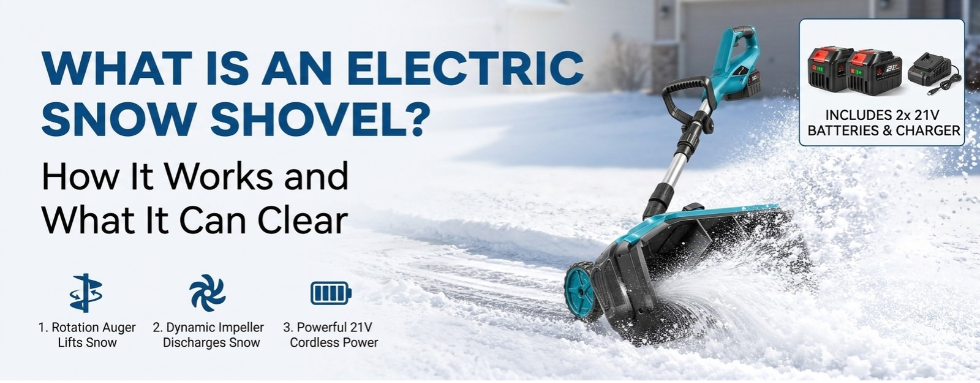
Electric snow shovels have become a popular alternative for homeowners who want something lighter and easier to handle than a full-size snow blower. These compact motorized tools are built for small jobs rather than big driveways, which makes it important to know whether one fits your needs before you buy. This guide provides you with the essentials: what an electric snow shovel is and how it works, the types of snow and surfaces it handles well, its main advantages over manual shoveling, and the limits you should expect, such as wet or deep snow and large areas. We’ll also cover corded versus cordless models, so you can decide if one is right for your home.
1. What Is an Electric Snow Shovel?
An electric snow shovel helps you clear snow without the heavy physical effort of using a manual shovel. It uses an electric motor that is powered by a lithium-ion battery or a continuous power cord. It drives a high-speed rotating paddle blade called an auger. As you push the tool, the spinning auger scoops snow directly off the ground and launches it forward through an exit mouth.
The reason homeowners use an electric snow shovel is to bridge the gap between hand shoveling and heavy gas equipment. It is built for tight spaces, steps, small decks, and short paths where a large snow blower is too wide or heavy to maneuver.
Electric Snow Shovel vs Traditional Manual Snow Shovel
Shoveling snow by hand creates acute pressure on your lower back. When lifting, your spine bends while twisting to throw weight off to the side. A single shovel load of wet snow weighs between 10 and 20 pounds. Clearing a standard 50-foot walkway means manually lifting over 1,000 pounds of total snow mass.
Electric shovels remove the lifting and throwing movement entirely. The rotating auger does the work by slicing through the snow layer, lifting it onto the curved paddle blades, and using centrifugal force to throw it away. Therefore, your body only handles simple forward pushing, which greatly reduces back strain and shortens clearing time.
Electric Snow Shovel vs. Manual Snow Shovel
|
Feature |
Electric Snow Shovel |
Manual Snow Shovel |
|
Power source |
Corded or battery |
Your own muscle |
|
How it moves snow |
Motor-driven auger throws snow aside as you push |
You lift, carry, and toss each load |
|
Typical clearing width |
10-16 in. |
About 18 in. (blade) |
|
Typical clearing depth |
6-8 in. |
Limited only by what you can lift |
|
Throw distance |
Up to about 20-25 ft |
None; you place the snow yourself |
|
Weight |
About 10-19 lbs |
About 4-5 lbs |
|
Best snow conditions |
Light to moderate, powdery snow |
Any type, including wet, heavy, or icy snow |
|
Physical effort |
Low; mostly pushing |
High; repeated lifting and twisting |
|
Ongoing needs |
Charging or an extension cord |
None |
|
Upfront cost |
Moderate (roughly $80-$150+) |
Low |
|
Best for |
Steps, decks, walkways, small driveways |
Tight corners, ice, heavy snow, quick touch-ups |
Corded vs Cordless Electric Snow Shovels
Corded electric shovels draw power straight from an outdoor wall outlet through an extension cord. This provides continuous motor power with zero downtime. On the other hand, dragging a 50- to 100-foot cord creates frustrating snags on steps, bushes, and ice patches. Cold outdoor temperatures also make heavy-gauge cords stiff and difficult to coil.
Cordless models fix movement limits by using high-voltage lithium battery packs. A good example is the ONEVAN 12" Foldable Brushless Handheld Cordless Snow Shovel. You can carry it anywhere without cord limits. Just make sure to store your battery packs inside a warm house before clearing. Sub-zero temperatures slow down the chemical reaction inside lithium cells, which lowers available voltage and reduces your working time by up to 30%.
|
|
Corded |
Cordless |
|
Power source |
Wall outlet through an extension cord |
|
|
Run time |
As long as you need |
About 20 to 45 minutes per charge |
|
Where you can use it |
Within reach of the cord, around 50 to 100 feet |
Anywhere, no cord to manage |
|
Cold weather |
Cord gets stiff and hard to coil |
Battery loses power in the cold, up to 30% less working time |
|
Setup |
Plug in and go |
Charge the battery beforehand and keep it indoors until use |
|
Weight |
Lighter, since there’s no battery |
A bit heavier with the battery attached |
|
Annoyances |
Cord snags on steps, bushes, and ice |
Battery can die halfway through a job |
|
Best for |
Short paths close to an outlet |
Steps, decks, and paths far from the house |
|
Upfront cost |
Usually lower |
Usually higher |
Important Features of an Electric Snow Shovel
Brushless Motor
Uses electronic sensors instead of mechanical carbon brushes to transfer power. This design creates less heat, uses less battery energy, and maintains high rotation speed under heavy snow loads.
High-Density Polyurethane Auger
Made from flexible composite plastic rather than rigid metal. The blades bend slightly when striking stone edges or uneven paver joints, preventing internal gear damage while protecting your deck surface.
Two-Step Safety Switch
It requires you to push a side thumb lock while squeezing the main trigger. This mechanical lockout stops the auger from spinning by accident when carrying the unit.
Adjustable Shaft and Handle
Uses a sliding locking collar so you can adjust the length of the main tube to match your height, preventing posture stooping during use.
2. How Does an Electric Snow Shovel Work?
Single Stage Auger Design
Electric snow shovels operate using a single-stage mechanical drive. The electric motor connects to a central drive shaft via a reinforced rubber belt or a gear reduction box or gear reduction box.
When you squeeze the trigger, the motor spins the front auger at speeds between 1,800 and 2,500 RPM. As the tool moves forward, the curved edges of the spinning blades bite into the snow layer, pull it inside the scoop housing, and accelerate it upward. Because the paddle blades touch the ground directly and double as the throwing mechanism, energy transfer is direct with minimal mechanical power loss.
How The 3-Way Adjustable Snow Discharge Works
Standard shovels toss snow straight ahead in front of your walking path. Advanced models use front deflector vanes to control output direction without adding heavy weight.
Inside the front exit mouth, four vertical plastic fins pivot on top and bottom hinge pins. A control lever near the handle connects to these fins through a thin mechanical rod. Moving the lever left or right shifts the fins up to 30 degrees off-center. As snow flies off the fast-spinning auger, it strikes these angled fins and changes direction to the side, preventing cleared snow from blowing back onto your fresh path.
What Makes It Different From a Snow Blower
|
Feature |
Electric Snow Shovel |
Two-Stage Snow Blower |
|
Clearing System |
Single Spinning Auger |
Auger and Secondary Fan |
|
Snow Direction |
Throws Straight Ahead or Side Vanes |
180-Degree Adjustable Chute |
|
Ground Touch |
Touches Pavement Directly |
Raised Off Ground on Skids |
|
Average Weight |
9 to 22 lbs |
80 to 250+ lbs |
|
Clearing Width |
10 to 14 inches |
20 to 30+ inches |
3. What Kind of Snow Can an Electric Snow Shovel Clear?
Best Snow Conditions For Electric Snow Shovels
Electric snow shovels perform best in fresh, dry powder with low moisture content. Accumulations between 2 and 6 inches deep allow the fast-spinning auger to slice cleanly to the pavement without bogging down the motor control board.
Cold, fluffy snow requires very little force to accelerate, allowing the tool to reach its maximum throwing distance of up to 20 feet.
Where You Can Use an Electric Snow Shovel
-
Wooden Decks and Composite Patios: The plastic auger edge and light weightdesign clear snow without scratching wood stain finishes or damaging composite surface coatings.
-
Front Steps and Porches: The narrow housing lets you step up each rise, clearing individual stair treads top-to-bottom.
-
Narrow Sidewalks: The 10- to 14-inch body clears tight paths between retaining walls, fences, and garden beds where wider tools get stuck.
-
Around Parked Vehicles: Compact dimensions allow you to clean tight spaces between cars without risking metal-on-paint scratches.
What An Electric Snow Shovel CANNOT Handle
-
Heavy Wet Slush: Water-soaked snow weighs over 30 pounds per cubic foot. Heavy slush sticks to the inside of the scoop housing, clogs the exit mouth, and triggers the motor's automatic thermal shutdown.
-
Plow Piles at Driveway Ends: Street snowplows pack snow, salt, and dirt into dense, heavy banks. Single-stage plastic augers lack the weight and mechanical force needed to break through packed walls.
-
Solid Ice: Electric shovels cannot chip or slice ice. Hitting frozen ice blocks creates high back-torque that can strip belt teeth or snap the internal composite drive gears.
4. How to Choose Between Handheld and Wheeled Electric Snow Shovels
Handheld Lightweight Electric Snow Shovel
Handheld configurations, such as the ONEVAN SKU007190 cordless shovel, focus on weight reduction and agility. Weighing under 10 pounds, these units use an adjustable mid-handle and optional shoulder strap to balance the weight across your upper body.
To clear a path, you hold the tool slightly off the ground, set the front intake down at the start of your line, and push forward. Because you can lift the entire unit easily, handheld models excel on stairs, elevated porches, and uneven stone paths.
Wheeled Foldable Electric Snow Shovel
Wheeled variants, like the ONEVAN SKU007315 shovel with wheels, feature a rear axle and two wide plastic wheels mounted behind the clearing head.
The axle acts as a pivot point that carries the tool's weight. Instead of holding the shovel up, you leverage the handle downward slightly to balance the intake deck, then push it forward along the ground. This design transfers physical effort from your arms and shoulders to your legs, making it easier to clear long, flat driveways and sidewalks.
Quick Comparison Table: Handheld Vs Wheeled Electric Snow Shovel
|
Feature |
Handheld Electric Shovel (SKU007190) |
Wheeled Electric Shovel (SKU007315) |
|
Support System |
Hand Grips and Harness |
Rear Wheels |
|
Best Surface |
Steps, Porches, Decks |
Long Flat Paths and Driveways |
|
Physical Effort |
Medium (Lifting Required) |
Low (Rolls on Ground) |
|
Clearing Path |
10 to 12 Inches |
12 to 14 Inches |
|
Storage |
Folds Small |
Frame Folds Flat |
5. Electric Snow Shovel vs. Cordless Snow Blower
Core Structural Difference: Rotating Chute
The primary design difference between an electric shovel and a snow blower is how they direct thrown snow. Electric shovels use a fixed scoop housing with short front vanes, throwing snow straight ahead along your line of travel.
Dedicated snow blowers use a fully enclosed metal intake box paired with an elevated 180-degree directional chute. A manual crank or electric motor rotates this chute left, right, or forward. This allows you to throw snow far off to the side regardless of which direction you are pushing the machine.
Snow Clearing Capacity, Throwing Distance & Usable Scenarios
In terms of working capacity, snow blowers handle much larger areas. Electric shovels max out at 6 inches of light snow and throw up to 20 feet.
A dedicated snow blower uses a two-stage system—an auger to collect snow and a secondary high-speed fan to hurl it—clearing depths up to 12 inches and throwing snow 35 feet away. Therefore, snow blowers are necessary for multi-car driveways where pushing snow straight ahead would pile it up into impassable ridges.
When Should You Upgrade To a Cordless Snow Blower?
You should consider an upgrade to a full unit, such as the ONEVAN 20-inch cordless snow blower, if:
- Your area receives more than 6 inches of accumulation per storm.
- You clear a driveway that fits 3 or more vehicles.
- Municipal plows leave dense, frozen snow banks across your driveway entrance that your electric shovel cannot break.
6. Conclusions
An electric snow shovel is a fast, effective tool for clearing light snow from your paths. First, the motor spins a fast blade that throws snow for you, so you can avoid painful back strain. Second, it saves you time during cold winter mornings. For example, lightweight handheld shovels give you the freedom to clear steps and small decks easily. On the other hand, wheeled models help you push snow along long, flat paths without extra lifting. However, if you face heavy wet snow or have a large driveway, a cordless snow blower is a better choice. It gives you more power and wide side-chute control for deep snow.
7. FAQs
Can an Electric Snow Shovel Remove Ice?
No. Electric shovels use plastic auger blades designed to scrape flexible surfaces. Striking hard ice creates shock loads that can snap the internal composite drive gears and strip the belt teeth.
How Long Will The Battery Last On a Cordless Electric Snow Shovel?
Most lithium battery packs run for 20 to 45 minutes on a full charge. Heavy, wet snow increases resistance against the motor, causing the control board to draw more current and drain the battery faster than dry powder.
Can I Use a Cordless Electric Snow Shovel In Cold Weather?
Yes, you can use it in freezing temperatures. Just make sure to store your lithium battery packs indoors at room temperature until right before work so they keep their full voltage output.
How Far Can an Electric Snow Shovel Throw Snow?
In dry powder snow, electric shovels throw between 15 and 20 feet. Heavy wet snow or strong headwinds will reduce that distance to 5 to 10 feet.
Can an Electric Snow Shovel Be Used On Gravel Surfaces?
No, you should avoid gravel paths. Single-stage augers touch the ground surface directly and will pick up loose stones, throwing them at high speed, which can cause injuries or break the plastic housing deck.
What Is The Lifespan Of an Electric Snow Shovel?
With dry indoor storage and proper battery care, a quality electric snow shovel lasts between 5 and 8 years.
Is a Brushless Electric Snow Shovel Better Than a Brushed Version?
Yes. Brushless motors run cooler, deliver higher torque when working through heavy spots, and eliminate internal brush wear, giving the tool a longer working life.