Choosing the best cordless screwdriver depends on various factors, including the type of projects you frequently undertake and the materials you commonly work with. For example, if you can't adjust the power, you will break screw heads or ruin the material. For larger projects like building a deck, a higher voltage (18V) screwdriver is recommended for increased power and efficiency. For smaller tasks such as assembling furniture or working with electronics, a low-voltage tool (around 4V) is safer, reducing the risk of over-tightening. Don't just buy a famous brand. A battery-powered screwdriver lets you control the speed and stops exactly when the screw is flat against the surface. If you use a heavy tool for a small screw, you will break it.
1. Why Choosing the Right Cordless Screwdriver Matters
Importance of Selecting a Tool Tailored to Your Tasks
It is crucial to match the screwdriver not only to the material but also to the specific tasks and types of screws you use most frequently. For instance, a 4V model is perfect for fixing a computer or a toy. However, if you are building a bookshelf, you need a tool with 8V or 12V of power. This is because lower voltage motors may not provide sufficient torque to drive screws into hardwood. On the other hand, using a heavy drill for small electronics is a mistake. It is too bulky to fit into tight corners and might crush delicate parts.
Benefits of Using a High-Quality Cordless Screwdriver
Precision Control and Torque
A good tool gives you a smooth start. If the screwdriver starts too quickly, the bit may slip, potentially damaging the surface of your workpiece. For example, look for a variable speed trigger. This lets you turn the screw slowly at first to keep it straight. This control is why expensive models are better for fine furniture work.
Balance and Weight
If a tool is top-heavy, your wrist will feel sore after ten minutes. The best cordless screwdrivers have the weight centered in the handle. You should look for a rubber grip that stops your hand from sliding. This is helpful when you are working in a hot room or above your head. Although a metal body is strong, a high-quality plastic shell is often preferable because it keeps the tool lightweight.
Battery Life and Storage
You should check the Amp-hour (Ah) rating on the battery. A 1.5Ah or 2.0Ah battery is enough for a full day of light home repairs. High-quality tools typically use lithium-ion cells that retain their charge better than other types, even after a month of inactivity. Lower-quality batteries tend to lose power when left unused in a drawer. So, when you finally need the tool, a cheap one will be dead, but a quality one will be ready.
Long Term Savings
Spending more on a reputable brand saves you money over time. The internal gears in cheap screwdrivers are often made of plastic. These gears strip if you try to drive a long screw. A tool with metal gears lasts for years. While the initial cost may be higher, investing in quality tools can reduce the frequency of replacements over time.
2. The Features of the Best Cordless Screwdrivers
Power and Torque
What the Parameter Is
Voltage (V) measures the electrical potential of the battery. Higher voltage allows the motor to produce more work without stalling. Torque is the rotational force, measured in Newton-meters (Nm). Most tools use a mechanical clutch to disengage the motor at a set resistance level.
How to Check It
Look for the V rating on the battery pack. For torque, check the spec sheet for Max Stall Torque. Inspect the ring behind the chuck; it should have clear, embossed numbers from 1 to at least 15.
How to Select It
Small Tasks (3.6V–7.2V / 3–7 Nm): Ideal for M3 to M5 machine screws found in laptops or flat-pack hinges.
Home DIY (12V / 10–30 Nm): Best for 40mm–60mm wood screws. Look for a tool that offers at least 20 clutch positions to fine-tune the depth.
Professional Work (18V+ / 40Nm+): Necessary for structural timber screws or self-tapping metal fasteners where high resistance is constant.
Battery Type and Capacity
What the Parameter Is
Lithium-ion (Li-ion) uses cobalt or manganese cathodes to provide high energy density. Capacity, measured in Amp-hours (Ah), is the fuel tank size. A higher Ah rating generally indicates a greater capacity for energy storage, resulting in longer runtime between charges.
How to Check It
The label must state Li-ion. The Ah rating is usually on the bottom of the battery. A 2.0Ah battery typically features a single-layer cell configuration, making it lighter, while a 4.0Ah battery has multiple layers and is therefore heavier.
How to Select It
Battery Type: Avoid NiCd; it suffers from memory effect and loses 1% of its charge daily while idle. Li-ion stays at 95% charge for months.
Runtime: A 2.0Ah battery on a 12V tool can drive approximately 200–300 standard wood screws. Choose 4.0Ah only if you are working overhead or away from a charger for several hours.
Motor Configuration
What the Parameter Is
Brushed motors use physical carbon blocks to pass current to the spinning rotor. Brushless motors utilize an electronic controller to manage electricity flow to the coils, eliminating the need for brushes and thus reducing wear and increasing efficiency.
How to Check It
Look for the word brushless on the tool's housing. If you see sparks inside the vents near the back of the tool when it stops, it is a brushed motor.
How to Select It
Brushless: Choose this for 30% more runtime per charge and a motor life that lasts 10x longer.
Brushed: Select only for light, occasional use, where the tool will sit in a drawer for most of the year.
Chuck Type and Size
What the Parameter Is
The chuck is the interface between the motor and the bit. The 1/4-inch Hex is a six-sided locking system. Quick-Change chucks use a spring-loaded sleeve and a ball-bearing detent to lock the bit into a groove on the shank.
How to Check It
Pull the metal collar on the front of the tool. If the collar snaps back and securely locks the bit in place, it indicates that the tool features a quick-change chuck system. Check if the bit wobbles when spinning; less wobble means better precision.
How to Select It
Select a Quick-Change chuck for one-handed bit swaps.
Ensure it is 1/4-inch. This allows you to use impact-rated bits, nut setters, and hex-shank drill bits.
Build Materials and Durability
What the Parameter Is
Durability is determined by the housing material and the internal gears. Better tools use Glass-Filled Nylon (PA6-GF30), which can survive a 2-meter drop onto concrete. The IP Rating (Ingress Protection) measures the seal against fine particles and liquids.
How to Check It
Check the Materials section of the manual. Ensure that the rubber over-mold is chemically bonded to the plastic rather than simply adhered with adhesive, which may not provide the same durability. For the IP rating, look for IP54 (Dust protected/Splash resistant).
How to Select It
For Longevity: Choose a tool with all-metal planetary gears. Plastic gears will strip under high heat or heavy torque.
For Environment: If working in dusty attics or damp crawlspaces, an IP54 rating is a requirement to prevent circuit board failure.
Additional Functional Features
What the Parameter Is
LED Systems: Provide enhanced visibility and shadow-free illumination of the fastener, improving accuracy during use.
Electric Brake: An internal circuit that reverses the magnetic field to stop the motor instantly.
Electronic Torque Control: Uses sensors instead of a mechanical spring to stop the motor.
How to Check It
Pull the trigger halfway to check if the LED illuminates prior to the motor activating, indicating the tool's readiness for use. Release the trigger; if the tool stops with a click and no coasting, it has an Electric Brake.
How to Select It
LED: Select a ring light (3 LEDs around the chuck) for the best visibility.
Electric Brake: Essential for precision work like cabinetry to prevent "over-driving" the screw head into the wood.
Switch: Choose a variable speed trigger rather than a simple on/off button for better control when starting a screw.
3. How to Choose the Best Cordless Screwdriver for Your Needs
Define Your Primary Use Scenarios
So the first point is to set your priority before you buy a battery-powered screwdriver. For example, how often you will use it. If you only assemble furniture occasionally, a lightweight tool with a compact battery is suitable for your needs. A professional who works every day needs a bigger tool with a strong grip, a large battery, and a belt clip. For home use, a 12V tool is sufficient.
How much you use the tool is just as important as how hard the work is. A cheap tool can last for years if you only use it for ten minutes every few weeks. However, a tool used every day must have a very strong motor. Do not spend too much money on a professional tool if you don't need it, but do not buy a weak tool if you have a big job to do.
Match Torque and Speed to Application Needs
The best screwdriver for electronics work looks noticeably different from a standard one. It's typically compact and pen-like, with a very fine clutch collar showing settings starting from 0.5–2 Nm, and a chuck that runs with zero visible wobble when you spin it by hand. If the tool you are evaluating has a clutch that only adjusts down to 4–5 Nm at its lowest setting, it is advisable to consider other options, as that torque level may damage a PCB or strip small brass threads in aluminum.
Most home improvement work sits comfortably in the 4–8 Nm range with a 2.0Ah battery. For most homeowners, a 12V brushless screwdriver with a clearly defined stepped clutch collar represents a versatile choice for a variety of tasks, a quick-change hex chuck, and a battery that clips securely into the base of the handle without wobbling. That description covers a lot of tools, which is good, because at this level, you have genuinely good options at a fair price.
For professional use, battery reliability matters as much as peak torque. A tool that maintains its performance consistently is more desirable than one that delivers full power for only a limited time before losing efficiency. Look for packs with quality cells, good thermal management, and a track record in trade use. If the battery gets noticeably warm during a standard session, that's heat being wasted — and capacity being eaten faster than it should be.
Battery Spare Sets and Charging Considerations
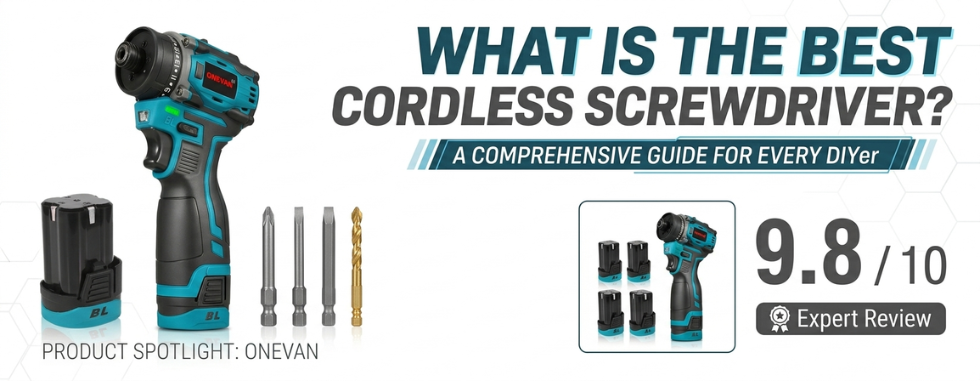
For professional use, two batteries are the minimum — one on the tool, one on the charger. A twin-battery kit costs less per battery than buying a second pack separately, and it eliminates the frustration of a flat battery mid-job. When you're comparing kits, look at how many batteries are included in the box image, and check whether the charger shown is a fast charger or a standard one.
Always charge at room temperature. Cold batteries charge more slowly and risk damage from fast charging. Storing batteries at 50–60% charge extends overall cycle life compared to storing them fully charged or fully flat. Most quality chargers have indicator lights that show charge state clearly.
Portability and Ease of Use
The compact form factor of a cordless screwdriver is one of its primary advantages over a full-size drill; therefore, it's important to choose a tool that maintains this benefit. The best screwdrivers for tight-access work are noticeably shorter than drills, with the battery tucked into the handle rather than hanging below it. For working in kitchen units, loft spaces, or electrical enclosures, the shorter body length makes access genuinely possible rather than awkward.
The ONEVAN cordless screwdriver range is designed with exactly this in mind — compact enough for confined spaces without sacrificing the torque settings and battery performance you actually need.
A quality quick-change chuck with a positive detent mechanism means two seconds per bit change rather than ten, one hand rather than two. You'll feel the detent click as the bit seats — a satisfying, solid engagement that tells you the bit is locked. On a cheaper chunk, bits push in without a clear click and can be pulled out with less resistance than feels right.
Evaluate Brand Reputation and Warranty
Brand reputation is everything. Cordless tool manufacturers are well-regarded due to their consistent quality and reliable performance. To find the best cordless screwdriver, ask a professional what they use. They usually pick tools that have long-lasting batteries and good customer service.
Before you buy, check the warranty and parts:
- The Warranty
- Coverage
- Service
- Extra Parts
4. Conclusion
Avoid focusing solely on specifications displayed on the packaging; consider the overall quality and suitability of the tool for your specific needs. A high-quality tool is designed for effective operation in tight spaces and is built to withstand drops, ensuring durability and functionality. Select a brand that offers a strong warranty and products equipped with brushless motors for optimal performance and reliability. Match the power to your specific work. By following these guidelines, you can ensure that your tool remains functional and reliable for many years to come.
5. FAQs
Cordless Screwdrivers: Is Higher Voltage Always Better?
No, and this is one of the most common buying mistakes. Higher voltage means more potential power, but also more weight and greater cost. A 3.6V pen-style screwdriver is an excellent choice for electronics and occasional household use. A 12V tool equipped with a quality lithium-ion battery pack is suitable for regular DIY and trade applications.
Matching voltage to actual need gives you better control and less fatigue — not just a bigger number on the box. However, if you are working on a construction site or driving long screws into thick wood, you need a high-voltage tool like the ONEVAN 16.8V Cordless Screwdriver. The reason is that 16.8V provides much higher torque than a 12V model. This allows you to finish difficult jobs faster without the motor overheating.
How Long Does a Typical Battery Charge Last?
On a quality 12V tool with a 2.0Ah lithium-ion pack, you can expect 45 to 75 minutes of constant driving time. If you move up to a 16.8V system, the runtime often improves because the motor does not have to work as hard to turn the screw. This efficiency means you can drive more screws before the battery dies.
While a 1.5Ah battery pack may suffice for quick fixes, a 2.0Ah pack is recommended for extended use, providing sufficient power for a full afternoon of work. For instance, if you are using a 16.8V tool for a large deck project, you will finish more of the job on a single charge compared to a lower voltage tool. For any extended session, you should always look for a kit that includes a spare battery.
Are Brushless Motors Superior for Cordless Screwdrivers?
Yes, in almost every meaningful way: longer motor life, higher efficiency, less heat generation, and more consistent torque delivery. If neither "brushless" nor "brushed" appears in the product listing, assume it's brushed. For a tool intended to last more than a couple of years of regular use, brushless is the correct choice — and the price gap between the two has narrowed significantly in recent years.
Can I Use the Same Batteries for Other Cordless Tools?
This compatibility largely depends on the manufacturer's design and specifications. Many brands design 12V and 18V batteries to be compatible across multiple tools in the range. Check whether the battery platform is shared before buying — if it is, you've potentially saved the cost of an additional battery and charger immediately. Look for the same voltage, the same connector shape, and the same brand logo on both the battery and any existing tools you own.
How Do I Know If a Cordless Screwdriver Is Suitable for Precision Electronics?
Look for three visible things: a clutch collar with settings starting at 0.5–2 Nm, a compact pen-style or slim pistol-grip form factor, and a chuck that spins true with no visible wobble when rotated by hand. If the clutch collar only shows coarse settings or the tool looks like a shrunken drill, it's not built for precision electronics work — move on.
What Are the Best Practices for Maintaining Cordless Screwdriver Batteries?
Here are four habits that can significantly extend battery life: store batteries at room temperature; avoid extreme cold or heat; keep batteries partially charged if not used for extended periods; and ensure battery contacts are clean. If the battery pack rattles when shaken, it indicates that the internal cells may have degraded, suggesting it should be replaced rather than continued to be charged.