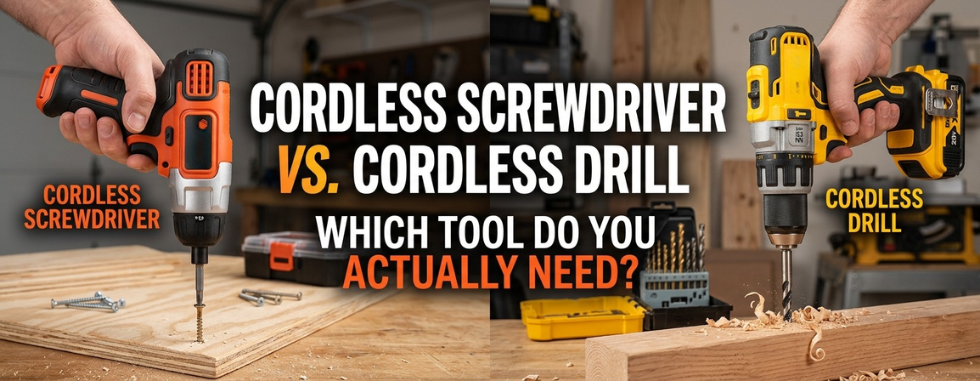
Estás en la ferretería y aquí ambas herramientas, el destornillador inalámbrico y el taladro inalámbrico, se ven similares. Una compra equivocada puede llevar a dificultades para completar tu proyecto, como dañar materiales más blandos o forzar el motor. Por lo tanto, este artículo te dará las diferencias técnicas reales para que compres la herramienta correcta a la primera.
1. ¿Qué es un destornillador inalámbrico?
Un destornillador inalámbrico es una herramienta eléctrica compacta construida para un solo trabajo: girar tornillos. Funciona con una batería de bajo voltaje, generalmente de 3,6 a 4 voltios, y gira entre 200 y 300 RPM. Esa baja velocidad es intencional. Ayuda a minimizar el riesgo de romper tornillos pequeños o dividir fibras de madera blandas cuando se usa correctamente.
Características principales de un destornillador inalámbrico
Pinza hexagonal
Su destornillador solo acepta brocas de vástago hexagonal a través de una pinza de un cuarto de pulgada. Una bola de acero y un resorte interno bloquean la broca en su lugar con un clic. Aquí, no hay funda que apretar ni mordazas que ajustar.
Batería
La mayoría de los modelos utilizan una única celda de iones de litio de 3,6 voltios, pero algunas versiones profesionales alcanzan los 12 voltios para una mayor duración. El menor voltaje generalmente resulta en un motor más compacto, lo que contribuye a un diseño liviano y fácil de manejar.
Velocidad controlada
El límite de 200 a 300 RPM significa que puedes ver cómo cada tornillo entra lentamente en el material. La probabilidad de pasarte y dañar una rosca se reduce a casi cero. Los kits premium como el kit de destornillador sin escobillas inalámbrico ONEVAN incluyen 21+2 ajustes de par para un control preciso de la profundidad. Ese rango de ajuste adicional es importante cuando cambias entre aglomerado blando y contrachapado ligeramente más firme en el mismo trabajo.
Diseño en línea
Muchos modelos pivotan entre un agarre de pistola y una forma de palo recto. A continuación se presenta el modo recto, que es lo que le permite alcanzar ranuras estrechas que bloquean cualquier otra herramienta.
Usos comunes de un destornillador inalámbrico
El montaje de muebles de paquete plano es el uso principal. La razón es que el aglomerado se agrieta con el exceso de fuerza, y un destornillador lento evita ese daño por completo. La reparación de productos electrónicos es otro buen ajuste. Los tornillos de las laptops y las cubiertas de las consolas de juegos se asientan en roscas de plástico, por lo que una sola ráfaga de alto par puede destruirlos permanentemente.
Otras tareas habituales incluyen la instalación de enchufes eléctricos en cajas de pared de plástico, el cambio de bisagras de armarios, la reparación de compartimentos de pilas de juguetes y la instalación de persianas. Todas estas tareas comparten un rasgo: el material es blando y los tornillos son pequeños.
Ventajas y desventajas de un destornillador inalámbrico
Pros:
- Pesa entre 0,3 y 0,5 kg, por lo que no se produce fatiga en la muñeca incluso después de sesiones prolongadas.
- El cuerpo delgado cabe dentro de los gabinetes de cocina y los paneles de electrodomésticos, donde los taladros inalámbricos no pueden entrar.
- La baja potencia evita que la herramienta se tuerza del agarre de un principiante.
- El precio de entrada asequible se adapta a personas que solo necesitan un mantenimiento doméstico ocasional.
- La batería integrada mantiene la carga durante meses durante el almacenamiento.
Contras:
- No tiene suficiente par para introducir tornillos en madera dura gruesa sin perforar previamente un agujero piloto.
- No puede hacer agujeros en ladrillo, metal o hormigón bajo ninguna condición.
- Los modelos básicos suelen tener baterías integradas que pueden requerir carga antes de que la herramienta pueda usarse, lo que puede provocar tiempos de inactividad.
- Ningún sistema de embrague mecánico pesado limita su rango de aplicaciones.
2. ¿Qué es un taladro inalámbrico?
Un taladro inalámbrico es una potente herramienta rotatoria que principalmente perfora agujeros e inserta fijaciones más grandes, con un voltaje que típicamente varía de 18 a 21 voltios. Utiliza un portabrocas sin llave de tres mordazas que sujeta brocas de 1 mm a 13 mm de diámetro. El voltaje oscila entre 18 y 21 voltios, y un sistema de engranajes planetarios en el interior traduce esa potencia en una gran salida de par.
Características principales de un taladro inalámbrico
Portabrocas sin llave de tres mordazas
Gira el manguito exterior para abrir o cerrar las tres mordazas de acero a mano. Este diseño acepta vástagos redondos, vástagos hexagonales, sierras de corona y paletas mezcladoras. Sin embargo, el collarín de tu destornillador no puede hacer nada de eso.
Caja de cambios mecánica multivelocidad
Un interruptor deslizante en la parte superior cambia las relaciones de transmisión. La posición 1 proporciona baja velocidad y alto par para tornillos grandes. A continuación, la posición 2, que proporciona alta velocidad y menor par para cortar agujeros limpios. Los dos ajustes hacen que esta herramienta sea capaz de realizar dos tipos de trabajo distintos.
Anillo de embrague ajustable
El anillo numerado detrás de la parte delantera del taladro controla las bolas de metal internas y los resortes. El ajuste 3 proporciona baja potencia. El taladro deja de girar tan pronto como el tornillo se siente un poco apretado. El ajuste 15 proporciona alta potencia. El taladro utiliza casi toda su fuerza antes de detenerse. Esto le ayuda a elegir la potencia adecuada para diferentes materiales. Algunos taladros utilizan motores especiales sin piezas de rozamiento en su interior. Esto elimina la fricción y ahorra energía. Como resultado, la batería dura mucho más.
Usos comunes de un taladro inalámbrico
Perforar agujeros es la tarea principal. Por ejemplo, los postes de madera para el tendido de cables, las placas de acero para el montaje de soportes y las paredes de ladrillo para los anclajes de estanterías, todos necesitan el rango de velocidad de 0 a 2000 RPM que proporciona un taladro. Sin embargo, un destornillador que funciona a 250 RPM no es adecuado para perforar y puede generar calor sin penetrar eficazmente materiales más densos.
La construcción al aire libre es otra aplicación importante. Cientos de tornillos largos para madera tratada para una terraza o valla requieren un par elevado sostenido, pero el motor del destornillador se detiene en los primeros cinco tornillos. Inserte una paleta mezcladora en el portabrocas y el taladro se convierte en una batidora de mortero o pintura. Añada una función de martillo y penetra el hormigón.
Ventajas y desventajas de un taladro inalámbrico
Pros:
- Maneja acero, madera dura, mampostería y plástico sin perder rendimiento.
- Las baterías extraíbles significan cero tiempo de inactividad en proyectos grandes.
- El portabrocas ajustable acepta varias brocas y accesorios.
- Funciona a alta velocidad durante horas con el ventilador de refrigeración incorporado, gestionando el calor.
Contras:
- Pesa de 1,2 a 2,5 kg, lo que provoca fatiga en el antebrazo durante el trabajo por encima de la cabeza.
- El cuerpo largo no encaja en paneles de electrodomésticos estrechos o armarios poco profundos.
- El alto par con un ajuste de embrague bajo destruye instantáneamente tornillos pequeños y superficies delicadas.
- Mayor costo de compra debido a la caja de cambios, el portabrocas metálico y el sistema de cargador de batería.
3. Destornillador inalámbrico vs. taladro inalámbrico: Comparación lado a lado
|
Característica técnica |
Destornillador inalámbrico |
Taladro inalámbrico |
|
Voltaje promedio |
3,6V a 4,0V |
18V a 21V |
|
Mecanismo del portabrocas |
Collarín hexagonal de 1/4 de pulgada |
Portabrocas de tres mordazas de 3/8 o 1/2 pulgada |
|
Velocidad de rotación |
200 a 300 RPM |
0 a 2000 RPM (variable) |
|
Par máximo |
3 a 6 Newton metros |
30 a 100+ Newton metros |
|
Peso de la herramienta |
0,3 a 0,5 kg |
1,2 a 2,5 kg |
|
Ajustes de velocidad |
Velocidad única solamente |
Caja de cambios de doble velocidad |
|
Tipo de batería |
Integrada (interna) |
Extraíble (deslizable) |
|
Capacidad de perforación |
Solo madera muy blanda |
Madera, metal, mampostería, plástico |
4. ¿Cuándo debería usar un destornillador inalámbrico?
Escenario 1: Montaje de muebles
Sin embargo, un destornillador inalámbrico normalmente proporciona la fuerza adecuada para colocar cada tornillo de montaje sin fracturar los agujeros pretaladrados si se usa correctamente. Terminas el mismo trabajo de montaje de muebles en 20 minutos en lugar de dos horas, y nada se agrieta.
Escenario 2: Instalación de anclajes y ganchos de pared
Los anclajes de plástico para paneles de yeso se expanden por presión, no por velocidad. Debido a que un taladro de alta velocidad derrite el plástico del anclaje antes de que complete su expansión, deja un agujero rasgado en la placa de yeso. Un destornillador lento empuja el anclaje a su posición y enrosca el tornillo central sin daños por fricción, por lo que el anclaje se agarra correctamente y soporta el peso.
Escenario 3: Trabajos en espacios reducidos
Un taladro inalámbrico es demasiado largo desde la carcasa del motor hasta la punta del portabrocas para caber dentro de un pequeño gabinete de cocina o debajo de un panel de salpicadero. Aquí, algunos destornilladores inalámbricos cuentan con un cabezal pivotante que permite cambiar de agarre de pistola a modo en línea, lo que permite el acceso a huecos profundos o estrechos. No es necesario quitar ninguna otra pieza para acceder al sujetador.
Escenario 4: Electrónica y electrodomésticos de uso ligero
Las placas de circuito se asientan en roscas de tornillos de plástico que se pelan con el más mínimo exceso de par. Su destornillador funciona a 250 RPM, lo que generalmente permite una operación más controlada, pero los usuarios siempre deben estar atentos para evitar pelar los tornillos. Por lo tanto, un taladro que funciona a velocidades más altas, como 1000 RPM, puede pelar rápidamente esa misma rosca si no se controla cuidadosamente.
5. ¿Cuándo debería usar un taladro inalámbrico?
Escenario 1: Perforar agujeros en madera, metal o mampostería
Cortar material requiere velocidad, ya que una broca elimina material girando sus bordes cortantes afilados contra la pieza de trabajo miles de veces por minuto. A 250 RPM, una broca de destornillador genera calor en lugar de acción de corte y quema su propio motor. Pero a 1500 RPM, un taladro inalámbrico corta un agujero redondo limpio a través de un poste de madera o una placa de acero en segundos. Puede elegir entre la colección de taladros percutores inalámbricos ONEVAN para trabajos de mampostería.
Escenario 2: Colocar tornillos grandes o pernos de sujeción
Un perno de sujeción estructural de 6 pulgadas crea una fricción enorme al enroscarse en madera densa. El motor de su destornillador alcanza su par de parada en la primera pulgada de entrada. La marcha de baja velocidad de un taladro inalámbrico mejora el par, lo que permite un atornillado eficaz de fijaciones grandes, siempre que el taladro se utilice dentro de sus límites operativos.
Escenario 3: Mezclar pintura, mortero o cemento
Fija una paleta mezcladora de acero en el portabrocas de tres mordazas y ajusta la marcha a la posición 1. La combinación de baja velocidad y alto par remueve mortero de azulejos espeso o pintura densa durante varios minutos continuos. Pero un portabrocas de destornillador no puede sujetar una paleta mezcladora de vástago redondo en absoluto.
Escenario 4: Proyectos de bricolajepesados
El enmarcado de paredes, la instalación de láminas metálicas para techos y la reparación de postes de hormigón requieren una herramienta que funcione durante horas sin apagado térmico. La razón es que la carcasa del taladro contiene un ventilador de enfriamiento interno que expulsa el calor del motor durante el uso continuo. Cuando la batería se agota, deslícela y reemplácela con un paquete cargado en tres segundos. Sin esperas, sin pausas en el proyecto.
6. ¿Se puede usar un taladro como destornillador?
Sí. Pero primero hay que cambiar dos ajustes, o dañará su material.
Cómo usar un taladro como destornillador (de forma segura)
Así es como puedes usar tu taladro de forma segura como destornillador, desglosado en tres pasos claros:
- Ajustar la configuración
- Insertar la broca
- Introducir el tornillo
Baje la velocidad: Mueva el interruptor selector de velocidad en la parte superior del taladro a la Posición 1 (baja velocidad/alto par). Ajuste el embrague: Gire el collar del embrague a un número bajo entre 3 y 5. Esto evita que el taladro apriete demasiado el tornillo o que la cabeza se redondee.
Abra las mordazas del portabrocas, inserte la broca del destornillador directamente en el centro y apriete el portabrocas por completo para que la broca no resbale durante el uso.
Sujete el taladro firmemente con ambas manos y alinee la broca completamente recta con el eje del tornillo. Presione firmemente la broca en la cabeza del tornillo y apriete el gatillo con ligera presión para mantener un control total.
Por qué no es ideal usar un taladro como destornillador
- Reconozca la tensión física
- Comprender el riesgo de desalineación
- Evitar que se pelen los tornillos
Sostener un taladro de más de 2 kg por encima de la cabeza para 50 tornillos de techo rápidamente causa fatiga muscular. A medida que sus brazos se cansan, su precisión disminuye, las cabezas de los tornillos se desgastan y corre el riesgo de dejar caer la pesada herramienta por completo.
El cuerpo largo de un taladro estándar hace que sea increíblemente difícil mantener la broca perfectamente centrada en las cabezas de tornillos pequeños mientras se trabaja hacia arriba.
La alta velocidad empeora la mala alineación; por ejemplo, una pequeña desviación angular de 2 mm a 1000 RPM desgastará instantáneamente la ranura de la cabeza del tornillo, arruinando el herraje.
7. ¿Se puede usar un destornillador como taladro?
No. Un destornillador inalámbrico estándar no puede perforar agujeros en metal, piedra o madera gruesa bajo ninguna condición práctica.
Por qué no es ideal usar un destornillador como taladro
1. Contraste la mecánica
Perforar agujeros requiere alta velocidad. Un taladro real gira a 1.000 RPM (revoluciones por minuto) o más rápido para cortar limpiamente madera o metal. Un destornillador inalámbrico es mucho más lento, girando a solo unas 300 RPM. Debido a que carece de velocidad y potencia, el destornillador se detendrá por completo en el momento en que la broca golpee una superficie dura.
2. Provocar la falla eléctrica
Cuando el destornillador deja de moverse porque está atascado, la batería no deja de funcionar. Sigue enviando electricidad al motor atrapado. Esto provoca que se acumule calor peligroso muy rápidamente dentro de la herramienta. En tan solo 30 segundos, la herramienta se sobrecalentará y comenzará a oler a plástico quemado y humo.
3. Experimente una avería total de la herramienta
Poco después de sobrecalentarse, la pequeña placa electrónica dentro de la herramienta se quemará. Esto destruye completamente el destornillador y nunca volverá a funcionar. El pequeño motor de 3,6 voltios está construido solo para girar tornillos, no para perforar agujeros. Para proteger su herramienta, nunca use un destornillador inalámbrico para perforar agujeros.
8. Cómo elegir la herramienta adecuada para tus necesidades entre un destornillador y un taladro
Paso 1: ¿Cuál es tu tarea principal?
Enumera las tres cosas que reparas con más frecuencia en casa. Si las tres implican tornillos pequeños, materiales blandos y agujeros pretaladrados, compra el destornillador. Sin embargo, si al menos una tarea requiere hacer un agujero nuevo o atornillar un tornillo de más de 3 pulgadas, el taladro es tu herramienta.
Paso 2: ¿Cuál es tu presupuesto?
Un destornillador inalámbrico de calidad cuesta una fracción de lo que cuesta un paquete de taladro. El precio del taladro incluye una caja de cambios, un portabrocas de metal, una batería extraíble y un cargador rápido. Si tu trabajo es ligero, por lo tanto, ese costo adicional no añade nada útil a tu juego de herramientas.
Paso 3: ¿Con qué frecuencia lo usarás?
Si solo necesitas apretar un tornillo suelto cada pocos meses, no necesitas comprar un taladro grande y caro. Un pequeño destornillador inalámbrico es perfecto para esto. Es fácil de guardar en un cajón de la cocina y no requiere cuidados especiales. Sin embargo, si planeas construir cosas los fines de semana o reparar tu casa, un taladro es una gran inversión. Te ayudará a terminar cientos de trabajos diferentes durante muchos años.
Paso 4: ¿Ya tienes baterías?
Muchas grandes empresas de herramientas utilizan la misma batería para todas sus herramientas. Esto significa que si ya tienes una herramienta de una marca específica, la batería de esa herramienta puede encajar en un taladro nuevo de la misma marca. Puedes comprar solo el taladro, sin pagar por una batería y un cargador nuevos. Esto te ahorra mucho dinero y evita que tengas piezas adicionales que no necesitas.
9. Entendiendo los ajustes de par: Evita pelar los tornillos
El par es simplemente una fuerza de torsión. Cuando utilizas una herramienta para girar un tornillo, la potencia de giro que aplicas se llama par. Es importante utilizar la cantidad de fuerza adecuada. Si utilizas demasiada fuerza, puedes romper la cabeza del tornillo. Si utilizas muy poca fuerza, el tornillo quedará flojo y podría caerse.
Par de un destornillador inalámbrico:
Un destornillador inalámbrico tiene una baja potencia de giro. Está diseñado para tornillos metálicos pequeños que se introducen en madera blanda o plástico. Como el motor es pequeño, la herramienta dejará de girar por sí misma si el tornillo encuentra un punto duro. No es necesario cambiar ninguna configuración ni tomar decisiones difíciles. La herramienta se protege de romper el tornillo, lo que la hace muy segura y fácil de usar para principiantes.
Par de un taladro inalámbrico (ajustes de embrague):
Un taladro inalámbrico tiene mucha potencia de giro. Para controlar esta potencia, los taladros tienen un anillo con números. Estos números controlan un resorte dentro del taladro. Los números bajos significan que el resorte está flojo. El taladro dejará de girar el tornillo tan pronto como sienta una pequeña resistencia. Los números altos aprietan el resorte firmemente. Esto permite que el taladro use toda su potencia para girar el tornillo antes de que se detenga. Cuando uses un taladro, siempre debes empezar con una configuración baja, como el número 3. Si el tornillo no entra del todo, sube el anillo dos números e inténtalo de nuevo.
10. Las reglas de seguridad esenciales para destornilladores y taladros inalámbricos:
Usa gafas de seguridad
Las virutas de madera y las limaduras de metal salen de la broca a gran velocidad. Por lo tanto, una viruta que entre en tu ojo causa un daño permanente. Debido a que las gafas graduadas estándar no protegen los lados de tus ojos, nunca debes omitir el uso de protección ocular adecuada. Usa gafas de seguridad envolventes clasificadas para protección contra impactos.
Retira los objetos sueltos
Una manga de camisa suelta, un anillo o un collar colgante pueden quedar atrapados en el portabrocas giratorio. El par de torsión jala la tela hacia la herramienta al instante. Por lo tanto, retira todo de tus manos y antebrazos antes de encender la herramienta.
Comprueba lo que hay dentro de una pared
Un detector de vigas digital detecta cables eléctricos ocultos y tuberías de agua de cobre detrás del yeso. Si perforas un cable con corriente, recibirás una descarga eléctrica y provocarás un incendio dentro de la cavidad de la pared al mismo tiempo. Esto solo toma dos minutos de verificación y previene un desastre.
Bloquea el interruptor de seguridad
Retira la batería o activa el seguro antes de cambiar las brocas. Un tirón accidental del gatillo mientras tus dedos están dentro de las mordazas abiertas del portabrocas causa un corte grave. El interruptor de seguridad te cuesta dos segundos, pero omitirlo te costará una visita al hospital.
11. Conclusión
¿Qué herramienta es adecuada para ti? Depende del material. Por ejemplo, los materiales blandos y los tornillos pequeños necesitan un destornillador inalámbrico. Sin embargo, los materiales duros, los agujeros nuevos y los sujetadores estructurales necesitan un taladro inalámbrico. Adapta la herramienta a la tarea y protegerás tanto tu proyecto como tu presupuesto.
12. Preguntas frecuentes
¿Vale la pena un destornillador inalámbrico?
Sí, si vives en un apartamento o en una casa pequeña. Maneja muebles de paquete plano, bisagras sueltas y pequeñas reparaciones sin el peso ni el coste de un taladro. Para trabajos de mantenimiento ligero, nada reemplaza su simplicidad.
¿Debo comprar un destornillador inalámbrico o un taladro inalámbrico?
Compra el taladro si solo puedes elegir una herramienta. La razón es que un taladro maneja trabajos de destornillador cuando bajas el ajuste de embrague. Sin embargo, un destornillador nunca puede perforar agujeros o introducir sujetadores grandes. El taladro cubre más situaciones.
¿Cuál es el mejor destornillador inalámbrico para uso doméstico?
Busca un modelo con embrague de par ajustable, batería de iones de litio y luz LED incorporada. Por ejemplo, un kit que incluya varias brocas hexagonales de diferentes tamaños te ofrece un mejor valor que comprar los accesorios por separado.