Introduction
Pruning shears are gardening tools that gardeners use to precisely cut small branches and leaves. They are handheld tools that you can use to remove dead branches, leaves, or woody structures that disturb the healthy growth of the plants. Pruners are essentially scissors, designed especially for plants. Gardening shears are big ones with larger blades and are used to trim big bushes and trees. Pruning shears are ideal for delicate tasks where you want to avoid damaging plant tissue while removing leaves or small branches. In this article, we will fully explain pruning shears, their types, when to choose a certain type, and how to use them correctly. Let’s start with the types of pruning shears.
What Are Pruning Shears and the Different Types
Let’s see different types of pruning shears and their ideal use cases.
What Are Pruning Shears?
Pruning shears are handheld tools used to make precise cuts on delicate plants without damaging surrounding tissue.
Common Types of Pruning Shears
There are a few commonly used types of pruning shears. For ease of understanding, let’s divide them by cutting mechanism and power source.
Cutting Mechanism and Design
By design, pruning shears have the following types.
Bypass Pruning Shearsare a type of pruning shear that has two blades that literally “pass by” each other, just like the blades of a pair of scissors that pass over each other at the end of the cut. Bypass shears are the primary type of shears, and you usually buy them first. If you only want to have one type of pruning shear, choose a bypass shear. These are extremely precise in their cuts and are best for trimming soft diseased or outgrowing branches and leaves. They make clean cuts and minimize damage to the surrounding plant tissue.
Anvil Pruning Shears are the second type of pruning shears that are best for trimming hard stems like dead ones, where you don’t care much about the damage to the remaining tissue. They have a blade and a hook or stopper, and the blade reaches to the middle of the hook at the end of the cut and stops against it instead of bypassing like in a bypass shear. Due to this mechanism, anvil pruning shears deliver a strong chopping action suitable for cutting hard branches efficiently.
Ratchet pruning shears refer to a mechanism incorporated primarily in some anvil shears, allowing the blade to cut thick branches in multiple steps. Most of the shears have a spring mechanism for the movement of the blades. But a special type of anvil shears that are designed for cutting tougher than usual blades. Such a shear cuts the branch in “clicks” or “steps” rather than a single move. You press the handle, the blade moves into the wood, you leave the handle, the handle resets, but the blade remains in this position. You then re-press the handle, and the blade cuts through further. This way you can cut a thick branch of wood in 3-4 steps. This mechanism is installed in anvil shears.
Power Source and Operation Mode
When it comes to power source, pruning shears can be:
Manual: They are mostly used by homeowners and DIYers. They just have a spring mechanism that works on its own without needing any external power supply.
Corded Pruning Shears: Corded shears have a cord that you plug in a power source. They are useful for long sessions.
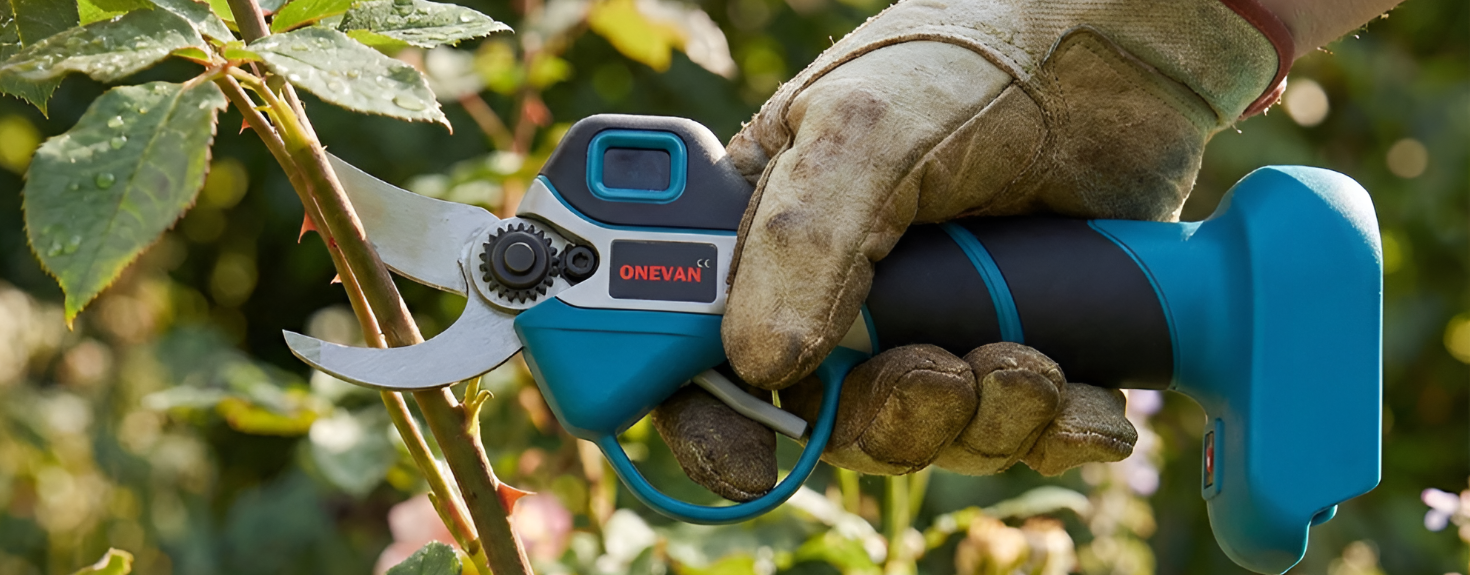
Cordless Pruning Shearsare a hot product in gardening tools (check them here). They have rechargeable batteries, so there is no hassle of cords. They are significantly more powerful than manual ones and are best for people with arthritis, weakness, or those who don’t want any strain on their hands.
Gas-Powered Pruning Shears: These are large machines and are used by professionals for large-scale trimming and gardening.
The Multiple Uses of Pruning Shears
Your gardening is incomplete without pruning shears, as they are needed for a lot of work in your garden. Here are the major tasks you need pruners for.
Trimming and Shaping Plants in Home Gardens or Landscapes
You want your lawn and garden to be in good shape and look beautiful. Pruning shears are used to cut and trim outgrowing branches of plants to keep them in an aesthetic shape. Shears cut back the overgrowth on bushes, like hedges and rose heads, and keep them looking tidy.
Removing Dead or Diseased Branches to Promote Health
Sometimes, a leaf or a branch of a plant rots or gets infected by a fungus. It’s important to cut that off so that the disease doesn’t spread further. You use pruning shears to access those small and delicate parts and cut them off cleanly, leaving no residue or damage. Bypass pruners work best for this purpose.
Encouraging New Plant Growth Through Selective Pruning
You can also use pruning shears to creatively manage plants' energy. When you cut a branch just ahead of a node, the plant tends to produce more branches sideways. This way you can get a plant to grow denser and bushier instead of growing tall and thin.
Harvesting Fruits and Vegetables in Orchards and Gardens
For small delicate fruits and vegetables like berries and grapes, you can use a pruning shear to snip the fruit from the plant cleanly. This method causes much less damage to the plant than manually pulling each of the fruits.
Caring for Bonsai and Container Plants
Bonsai is a Japanese art and culture of growing miniature plants in pots and giving them beautiful shapes by trimming. It’s a work of extreme delicacy and pruning shears are the main instrument used to fine-trim the bushes.
Preparing Plants for Repotting or Transplanting
When plants are being transported from one place to another, their roots are pruned for better growth in the new place. The circling and damaged roots are cut off, which stimulates the plant to grow new feeder roots for more efficient growth.
Deadheading Flowers to Prolong Blooming Season
Another creative use of pruning shears is to keep the flowers for a longer period than the natural blooming season. When a flower is about to die, you cut it off using pruning shears. Since the natural cycle of a flower is to produce seeds, and you interrupted it by cutting the flower off, it prompts the plant to produce more flowers in an effort to complete the cycle and produce seeds. This grows new flowers and the blooming season lasts a little longer.
How to Choose the Right Pruning Shears for Your Needs
Not every type of pruning shear is suitable for every type of task. Let’s briefly overview the features you need to look for in a shear, like type, blade quality, comfort, for your specific use case.
Matching Shear Type to Garden Tasks
We have talked about different shear types like bypass, anvil, and ratcheted, which can be manual or cordless. If you mainly have living and soft plants in your garden, a bypass shear will do the work. If you have small trees or you often have to deal with dead branches, buy an anvil shear.
Consider ratchet shears for cutting hard, woody branches thicker than 0.75 inches. It applies more power with less strain on your hand and thus is best for hard tasks.
Now, when it comes to manual and electrical choices, go for the manual one if you prune impulsively and occasionally whenever you see a queer branch. But if you are pruning seriously and do it for long hours, choose a cordless one likeONEVAN’s cordless pruning shear. Avoid corded ones unless you do really heavy-duty work on a regular basis.
Blade Quality and Comfort of Handles
Pruning shears usually have either a high-carbon steel blade or a stainless-steel blade. A high-carbon steel blade is a professional choice. It is harder and stays sharper than stainless steel blades. The catch is you have to oil it regularly. Otherwise, it’ll rust fast.
Stainless steel is the default choice of many homeowners and DIYers. It is resistant to rust and the blades work for long periods, but their blades get dull faster than high-carbon steel.
When it comes to the comfort of handles, manufacturers add various features like rubberized coatings on handles that give a smoother handling experience as compared to plastic handles. Some models feature rotating lower handles that circulate as you squeeze and reduce hand fatigue significantly. Some also have shock absorbers.
The higher-end model you buy, the more comfort you’ll get. If your hands tend to get fatigued or sore early during pruning, it might be worth investing in these features.
Considerations for Garden Size and Plant Types
For small gardens like on your balcony or patio, a bypass shear is all you need. It’ll do 99% of your pruning tasks, and you’ll rarely need an anvil shear. For a medium-sized garden, a bypass shear is suitable for most pruning, while anvil shears work best on dead or very tough branches. You may also need a larger pair of gardening shears for larger-scale trimming of your garden.
For very large gardens, you need all essential instruments, including larger gardening shears and smaller pruning shears of almost all types. For large and medium sized gardens and the people who have arthritis, muscle weakness, and other such problems, and still want to enjoy pruning, corded electrical shears are the best option. They require very little force to trim the trees and save hours of time.
Tips for Proper Use and Maintenance of Pruning Shears
Just like any other gardening tool, a pruning shear also needs proper care. It should also be used correctly to make sure that it keeps functioning for longer.
Correct Cutting Techniques for Different Plants
There are a few cutting tips that you need to keep in mind while using a pruning shear. Always cut at 45 degrees. A flat cut accumulates water, which can cause disease or rotting. While cutting a branch, cut around 1/4 inch away from the bud. Cutting too close can damage the bud, while cutting too far may leave behind a stub that can die back. Also, always keep the slant of the cut away from the bud.
When making a cut, position the sharp blade of the pruner against the plant, with the hook or anvil on the opposite side. It helps to get a precision cut rather than the back part being damaged.
Cleaning After Pruning to Avoid Contamination
You should always clean your shears when you switch from one plant to another, using a spray or dip of isopropyl alcohol. If you’re cutting dead or diseased branches, clean the pruners after every cut. If the blade is heavily contaminated, dip it in a solution of 1 part bleach to 9 parts water for 1-5 minutes, then rinse and dry thoroughly.
Basic Sharpening and Lubrication to Prolong Tool Life
Sharpen the blade using a diamond file or a whetstone. Sharpen only the beveled/angled edge. Move the file in one direction (into the blade) at an angle of 20-25 degrees. For lubrication, use penetrating oil or machine oil to lubricate the bolt or spring. Open the close the tool around ten times to let the oil in.
Conclusion
Pruning shears are an important tool for maintaining the delicacy, shape, and health of your garden. The main type is the bypass shear, which does 90% of the pruning job. Manual shears are preferred for light, occasional pruning by homeowners, but for longer or more frequent work, cordless pruning shears reduce effort and fatigue. It takes significantly less effort and is a lot more efficient and time-effective. Check outONEVAN’s collection of cordless pruning shears to get the best tools in the market.
FAQs
What’s the difference between bypass and anvil pruning shears?
Bypass pruning shears have two blades that pass by each other at the end of the cut, just like the blades of scissors. Anvil shears have a blade and a hook that the blades stop against at the end of the cut. Bypass shears are used for precise cuts, while anvil shears are used to cut dead parts.
How often should pruning shears be maintained?
Pruning shears should be cleaned and sanitized after every cutting session. You should oil and tighten them every 4-6 weeks if they are being used regularly.
Are cordless pruning shears suitable for home gardens?
Yes, cordless pruning shears are suitable for home gardens if you have a medium to big-size garden and you do prune regularly. They are especially useful if you have arthritis or you struggle with long pruning hours.
How to clean pruning shears after use?
Clean the shears by dipping or spraying them with isopropyl alcohol and cleaning thoroughly with a rag. If they are contaminated heavily dip them in bleach for 30 minutes.
What type of pruning shears are best for thick branches?
Anvil shears are best for cutting dead wood and branches up to about 1 inch in diameter. If branches are thicker than 0.5 inches, use ratcheted shears.
Can pruning shears damage plants if used improperly?
Yes, improper pruning techniques can damage plants by causing infection or poor wound healing. Make sure to cut at a 45-degree angle about 1/4 inch from the bud, keeping the slant away from it.
Are cordless pruning shears worth the investment?
Yes, they are worth the investment as they save tons of time and help you prune a decent garden effortlessly.
How long do pruning shears typically last?
Manual pruning shears can last 5 to 10 years with proper care. Cordless pruning shears’ motor units last about 5 years, but battery life and replacement vary depending on usage.